Next-Generation Smart Health & Physiological Monitoring Wearables
The Challenge: The development of next-generation medical wearables and research devices faces three critical hurdles: strict size constraints, demanding power consumption requirements, and pervasive signal noise. Commercial off-the-shelf components often fail to provide the medical-grade data accuracy required for advanced physiological monitoring in form factors small enough for unobtrusive daily wear.
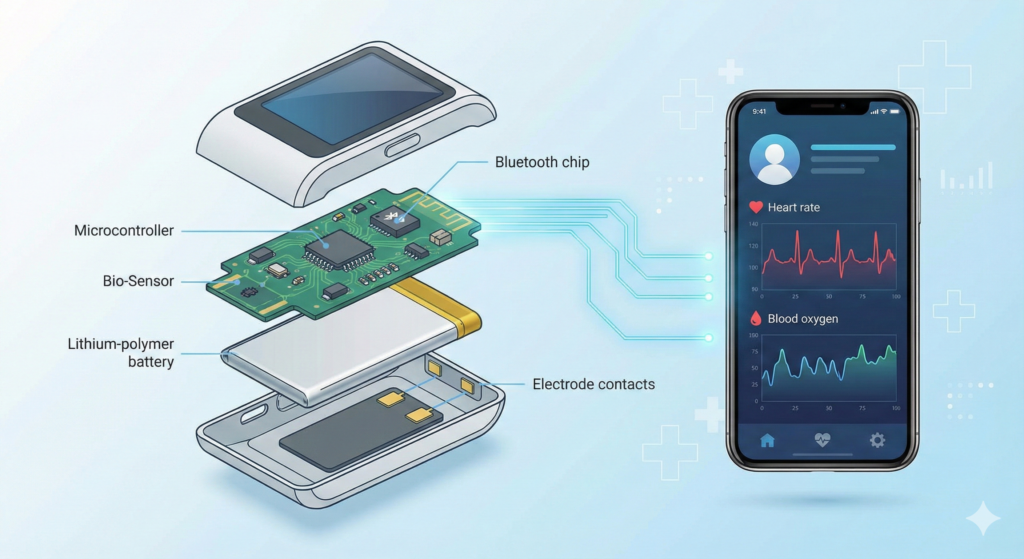
Engineering Approach: Our team engineered a custom hardware architecture designed specifically for miniaturized sensor integration. We developed bespoke ultra-small PCB designs tailored for ear-worn and wrist-worn applications. These boards seamlessly integrate highly sensitive PPG, ECG, and Core Body Temperature sensors. To address power limitations, we optimized the Bluetooth Low Energy (BLE) firmware, enabling continuous, multi-day data logging without the need for frequent charging.
Advanced Signal Processing: Collecting data in real-world environments introduces significant motion artifacts. To ensure pristine biosignal acquisition, we implemented advanced on-chip filtering algorithms. This embedded signal processing cleans the data at the source before transmission, drastically reducing the computational load on the receiving devices and improving overall system reliability.
Outcome: By overcoming the traditional tradeoffs between size, power, and precision, we successfully accelerated the development of a medical-grade physiological monitoring platform. Researchers and medical device startups can now capture continuous, high-fidelity biosignals in ultra-compact form factors.